
For commercial mechanical, HVAC and sheet-metal contractors
Working capital for mechanical and HVAC contractors
Your units are set, your ductwork is hung, and the last 10% of the job is waiting on startup, balancing and a commissioning agent's sign-off. Crossbrace Capital helps established mechanical contractors carry equipment and crews through long installs and slow closeouts, with a plain-dollar cost disclosure in states that require one.
5 taps. No contact details to see your number.
Check your cash gap
Up to 5 taps to an estimate. No contact details needed to see it.
Let's size the cash gap on a job. 5 taps at most, and you don't need to give contact details to see the number. Nothing is sent to us until you press Send at the end.
Your request is handled by Crossbrace Capital and its sister company Funding Futures, and either may call or email you about it. We do not sell your information. By pressing Send my request, I confirm I'm authorized to request business funding for this business and that it's for business purposes only. Automated calls and texts happen only if I checked those boxes. Privacy Policy · Terms · Disclosures
Why mechanical cash runs long
Mechanical jobs tend to be longer than other trade scopes, the terms tend to be longer (net 60 is common on commercial work), and the finish line is not when you leave the site. It's when the system has been started, tested, balanced and accepted. Until then, the final pay app and your retainage can sit.
That gives mechanical contractors two cash problems on the same job: a long climb to the first check, and a long tail at the end.
Typical job: a $650,000 mechanical scope
A hypothetical rooftop-unit and VAV package for a mid-size commercial building:
- $650,000 contract over 24 weeks
- Equipment and materials at 48% of the contract, about a third of it bought in the first three weeks
- $11,000 a week in burdened payroll
- Pay app every 4 weeks, paid net 60, with 10% retainage released 90 days after completion
What the calculator shows:
- Peak cash gap: about $343,000, in week 12. Net-60 terms push the first check out a full two weeks longer than net 45 would.
- First check: about $98,000, in week 13.
- Six monthly checks follow, the last one around week 33.
- Retainage: $65,000, around week 37, 13 weeks after the work is done, because release waits on commissioning.
- Margin: about $74,000 (11.4%). Almost all of it sits in retainage until the end.
Try your own job Open the calculator with this example
On a data-center job? See mechanical and piping subs on data-center work.
Your pay timeline
- Week 0Equipment orderedDeposits, sheet metal, crew
- Week 4You billPay app for installed work
- Week 12GC gets paidOwner pays the GC
- Week 13You get paidLess retainage
- Week 37Retainage releasedAfter startup and closeout
Week-by-week table
| Phase | What gates the money | Typical risk |
|---|---|---|
| Submittals and equipment release | Engineer approval of equipment submittals; then deposits or orders | Resubmittals push the order date and the delivery |
| Rough-in (duct, pipe, hangers) | Monthly pay app on percent complete | Net 60 means you carry two months of payroll before the first check |
| Equipment set | Delivery and crane day; billing on installed or stored equipment per contract | Stored-equipment billing may need insurance and title documents |
| Startup and test-and-balance | Manufacturer startup, TAB report | Other trades' delays (power, controls) hold you up |
| Commissioning and closeout | Commissioning agent sign-off, O&M manuals, training, warranty letters | Final pay app and retainage wait on paperwork |
| Retainage release | Owner acceptance and the release terms in your contract and state law | 90+ days is common; 43% of subs in one survey waited more than 90 days for retainage (Siteline, accessed 2026-11-17) |
Five mechanical pinch points
Equipment lead times
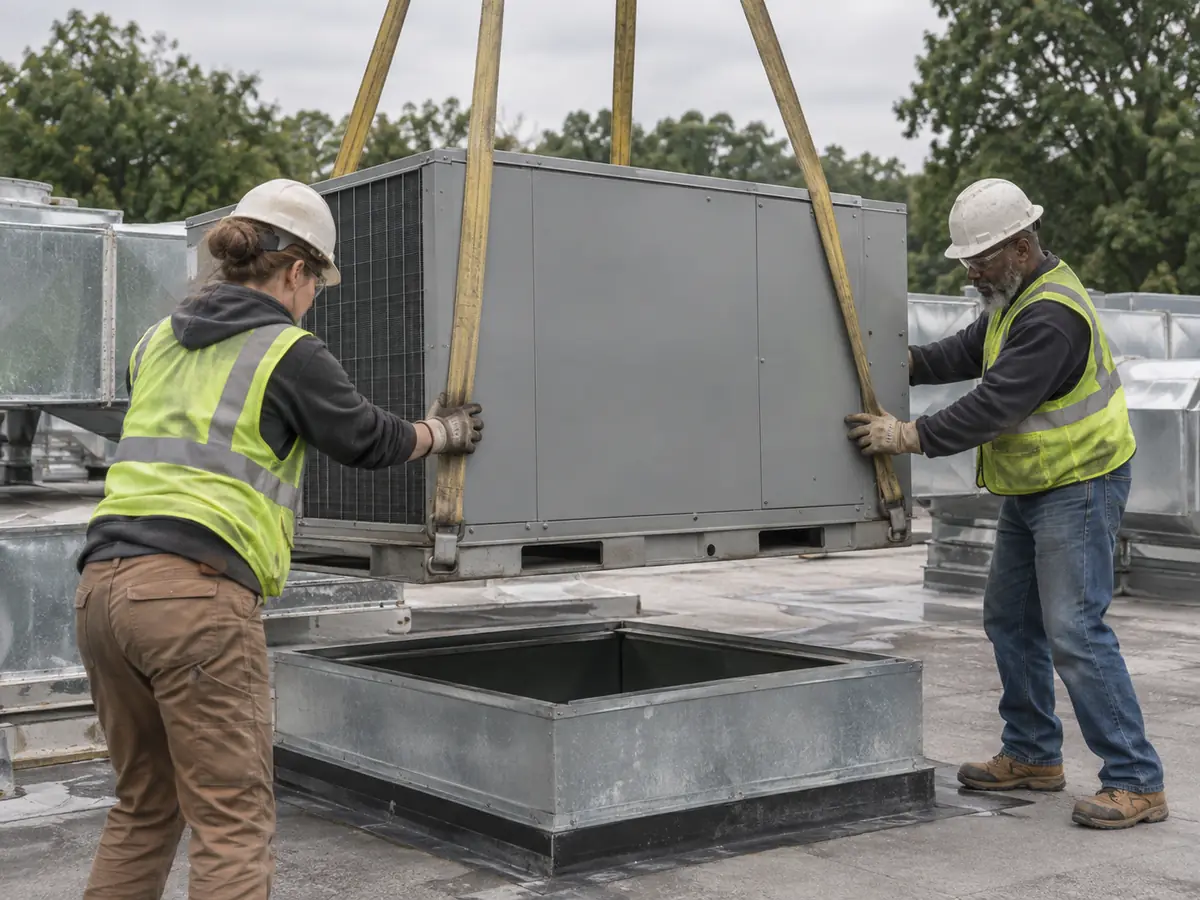
Long-lead units, chillers and air handlers may need a deposit when released, months before they can be billed as installed.
Net 60 on the prime's side
If the GC is paid net 30 by the owner and pays you 30 days after that, you're at 60 before you start counting review time.
Controls and power dependencies
You can't start a unit without permanent power and controls. When those trades run late, your startup billing does too.
Closeout paperwork
O&M manuals, as-builts, TAB reports and training sign-offs. Missing one can hold the final check.
Warranty and callbacks during the retainage period
Callbacks cost labor while retainage is still unpaid.
Service side vs project side
Many mechanical contractors run both: a service and maintenance book that pays in 30 days or less, and a project book that pays in 60 or more. The service side often carries the project side, until a slow season or a big project win throws it off.
If your gap is seasonal (stocking equipment before summer or heating season), it has a different shape than a project gap: it's predictable, and it ends when the season's invoices come in. Tell us which one you're solving for, because the right amount and term are different.
Nationally, nonresidential plumbing and HVAC contractors employed about 646,000 people in Q1 2026, up 3.6% from a year earlier (BLS QCEW, NAICS 238222, 2026 Q1, retrieved 2026-11-17).
Questions we ask mechanical contractors
- Is this a project gap, a seasonal gap, or both?
- What's the equipment schedule: release date, deposit, delivery?
- What are your billing terms and retainage, and what triggers retainage release?
- Who's the commissioning agent, and what closeout documents are required?
- How much of your monthly revenue is service versus project work?
- What do your business deposits look like over the last several months?
- Any existing advances, loans or equipment notes with daily or weekly payments?
Fit and no-fit
Usually a fit
Established commercial mechanical contractors with steady deposits, signed work and a gap that ends with a known check. One year in business is our only published minimum, and existing advances don't rule you out.
Usually not a fit
A gap with no clear end, a closeout dispute that may not resolve, or an equipment purchase that an equipment loan would finance more cheaply. When a bank line, supplier terms or equipment financing is the better tool, we'll say so (compare the options).
Product note: Crossbrace Capital is a direct funder. We fund mechanical and HVAC contractors two ways: business funding repaid on a weekly or daily schedule (for contractors, we lead with weekly), and receivables financing against invoices and pay apps you've already billed. Costs and terms depend on your business and are set out in writing before you sign.
FAQ
Can funding cover equipment deposits for a commercial job?
If materials and equipment for signed work are an approved use, yes. For a long-lived unit you'll own, compare the cost against equipment financing first.
My retainage is held until commissioning is done. How do you treat that?
As money earned but delayed. In our example, $65,000 arrived about 13 weeks after the work finished. We look at whether your other billings carry you without it.
Do you fund the seasonal stock-up before summer?
We look at it the same way: what goes out, when the money comes back, and whether your deposit history shows that pattern in past years.
I'm paid net 60. Is that a problem?
Not by itself. It makes your gap bigger and longer, so the amount and term need to match it. Run your terms in the calculator first.
Will I have to give my SSN to start?
No. The first step asks about your business and the job.
What does it cost?
It depends on the file. Ask for the total cost in dollars and the payment schedule before you sign. Required disclosures are provided in states that require them.
Keep reading
Guides and tools for mechanical and hvac contractors
Know your gap. Then talk to us.
Tell us about the job. If we're not the right fit, we'll say so.
No SSN, date of birth or bank login to start.