
For structured-cabling, fiber, security and access-control contractors
Financing for low-voltage and fiber contractors on data-center jobs
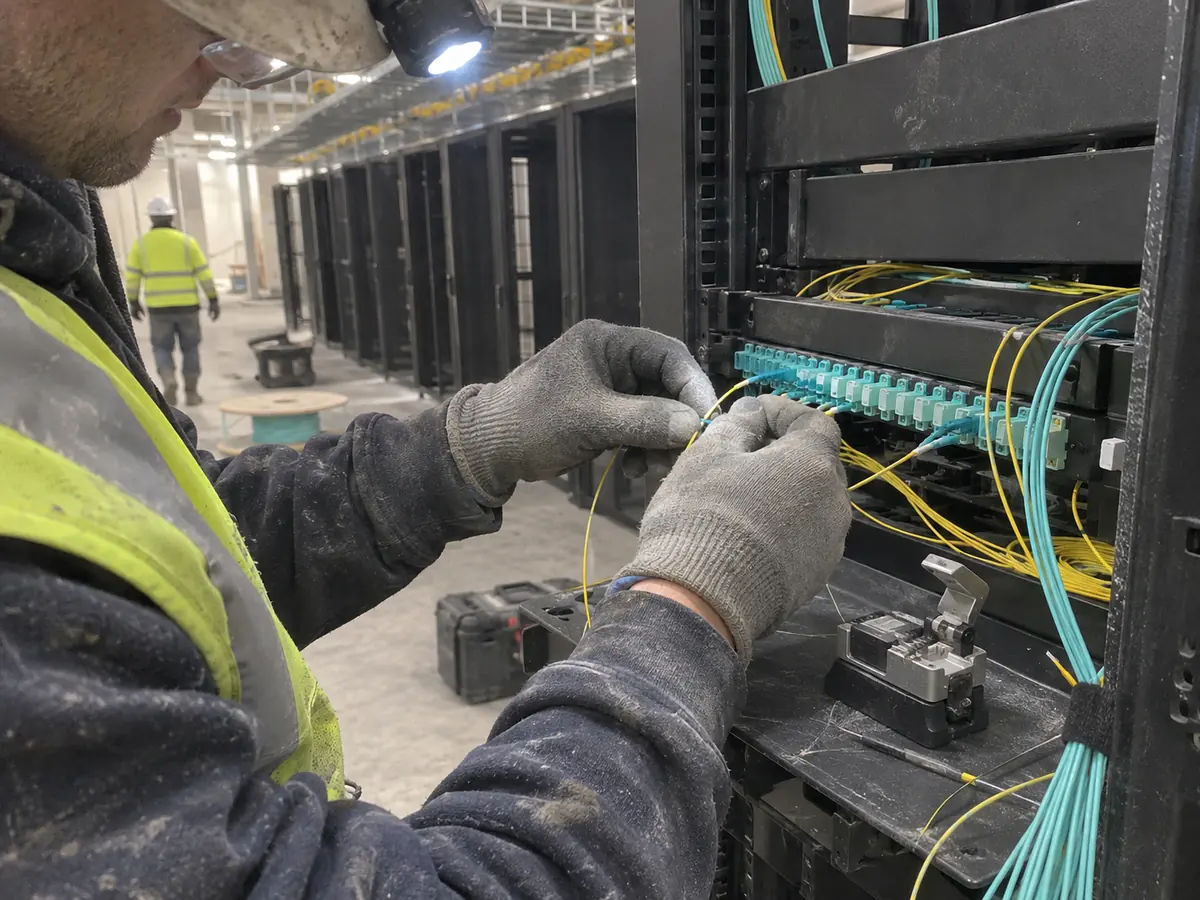
On a data hall, you may be three contracts down from the owner. The owner pays the GC, the GC pays the electrical contractor, and the electrical contractor pays you. Crossbrace Capital is a direct funder. We fund established low-voltage firms against approved pay apps, and with weekly-payment funding to carry techs until the checks catch up.
5 taps. No contact details to see your number.
Check your cash gap
Up to 5 taps to an estimate. No contact details needed to see it.
Let's size the cash gap on a job. 5 taps at most, and you don't need to give contact details to see the number. Nothing is sent to us until you press Send at the end.
Your request is handled by Crossbrace Capital and its sister company Funding Futures, and either may call or email you about it. We do not sell your information. By pressing Send my request, I confirm I'm authorized to request business funding for this business and that it's for business purposes only. Automated calls and texts happen only if I checked those boxes. Privacy Policy · Terms · Disclosures
Why low-voltage waits longest
You're deep in the chain
Each tier above you may have its own pay-when-paid clause. Subs already wait 51 days on average to be paid (Billd 2026); a third-tier firm can wait longer.
Labor is most of the cost
On many hyperscale halls the owner supplies cable, so your money goes to techs, travel and certification testers.
Retainage waits on everyone else
Your scope may be done months before the building is accepted. 43% of subs wait more than 90 days for final payment and retainage (Siteline, 2026).
Testing and documentation gate closeout
Certification results and as-builts have to be accepted before the last bill is paid.
What a $900,000 data-hall package can tie up
About $476,000 by week 12 on the preset, with an 11.7% margin. At 90 days, $583,000 in week 16. Illustration, not an offer: a hypothetical job, not a real client or terms. Run your own.
How we fund low-voltage firms
- Receivables financing against approved pay apps, net of retainage, repaid when the contractor above you pays.
- Business funding with weekly payments for techs, travel and test gear before you can bill.
At least 1 year in business; existing advances don't rule you out. Costs and terms in writing before you sign, with a plain-dollar cost disclosure in states that require one.
Protect yourself on a third-tier contract
- Ask what the tiers above you are paid on. If the GC is on an early-pay program, ask whether it reaches your tier.
- Send lien or bond notices on time. Deadlines are short and vary by state. In Ohio, a notice of furnishing is due within 21 days of first work on many private projects (ORC 1311.05).
- Bill testing and documentation as line items where the schedule of values allows.
- Ask for retainage reduction at substantial completion of your scope. Some subcontracts allow it; some states require pass-through when the GC gets its own retainage back (Georgia, O.C.G.A. 13-11-6).
Frequently asked questions
I'm a sub to the electrical contractor, not the GC. Can I still apply?
Yes. Your receivable is owed by the contractor you signed with. We'll ask who that is and how it pays.
The owner supplies the cable. Is my job still big enough to need funding?
Labor-heavy jobs still create a gap: payroll runs weekly and the first check can be 60 days or more after your first bill. Run the calculator with your crew size to see.
Can you fund retainage that's been held for months?
We plan around what's payable now, net of retainage. A good first step is a written request for release or reduction under your subcontract.
How long do I need to be in business?
At least 1 year.
Keep reading
Guides and tools for data-center subs
Know your gap. Then talk to us.
Tell us about the job and who pays you. If we're not the right fit, we'll say so.
No SSN, date of birth or bank login to start.