
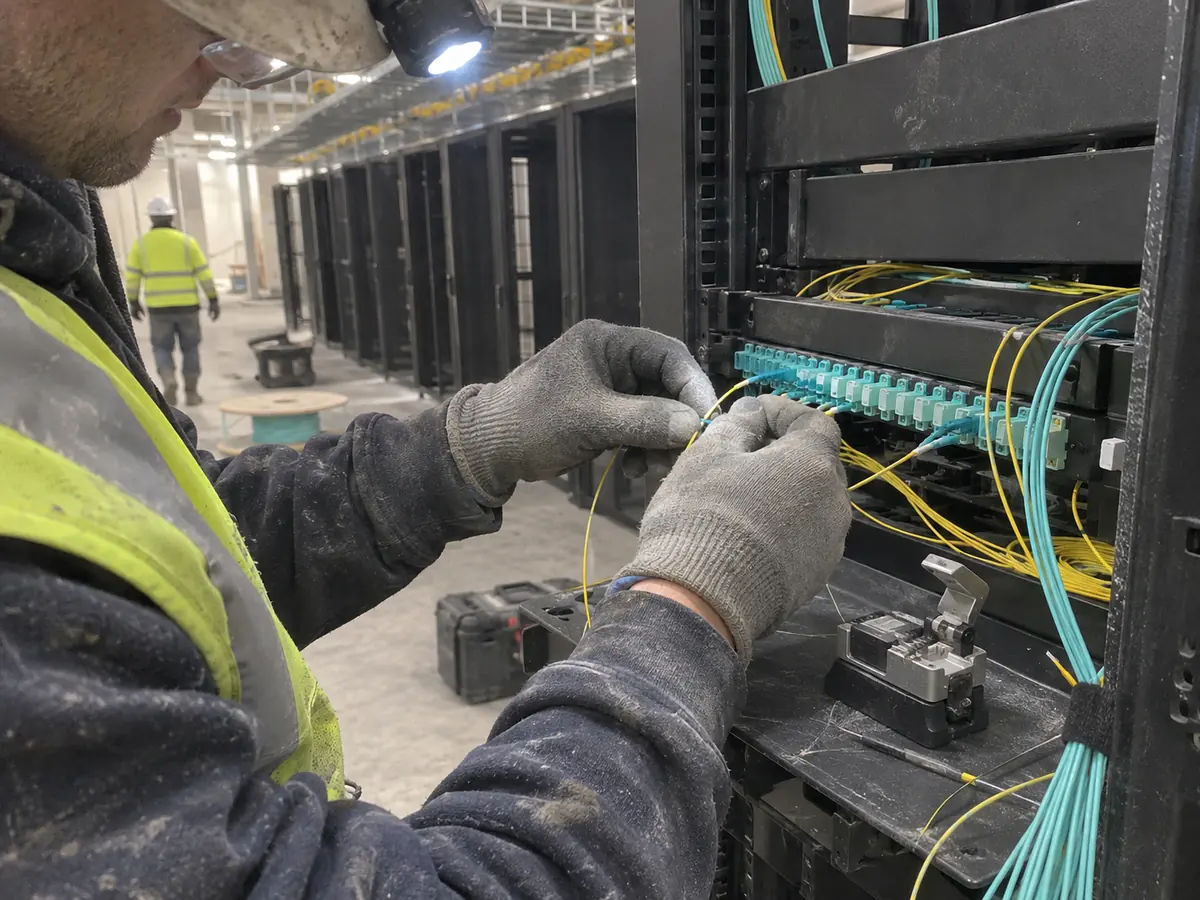
For structured-cabling, security, fire-alarm and AV contractors
Working capital for low-voltage and data-cabling contractors
By the time the owner pays the GC, the GC pays the electrician and the electrician pays you, your techs have been paid for two months. Crossbrace Capital helps established low-voltage contractors carry labor and cable through long payment chains, with a plain-dollar cost disclosure in states that require one.
5 taps. No contact details to see your number.
Check your cash gap
Up to 5 taps to an estimate. No contact details needed to see it.
Let's size the cash gap on a job. 5 taps at most, and you don't need to give contact details to see the number. Nothing is sent to us until you press Send at the end.
Your request is handled by Crossbrace Capital and its sister company Funding Futures, and either may call or email you about it. We do not sell your information. By pressing Send my request, I confirm I'm authorized to request business funding for this business and that it's for business purposes only. Automated calls and texts happen only if I checked those boxes. Privacy Policy · Terms · Disclosures
Paid last on a long chain
Low-voltage contractors often work under the electrical contractor, who works under the GC, who works for the owner. Every level reviews the pay app, and every level may have a pay-when-paid clause. Net 60 at your level isn't unusual.
The work itself is labor-heavy. Cable is a real cost, but your biggest expense is the technicians pulling, terminating, labeling and testing it, every week. And the job isn't done when the cable's in. It's done when every link is tested and the documentation is accepted.
Typical job: a $210,000 structured-cabling scope
A hypothetical cabling, pathway and rack package for an office fit-out, as a third-tier sub:
- $210,000 contract over 14 weeks
- Materials at 30% of the contract, half bought in the first two weeks
- $8,500 a week in burdened payroll
- Pay app every 4 weeks, net 60, 10% retainage released 90 days after completion
What the calculator shows:
- Peak cash gap: about $161,000, in week 12. That's about 88% of the job's total cost (computed: $161K of $182K).
- First check: about $54,000, in week 13.
- Final check around week 23, then $21,000 of retainage around week 27, three months after you finish.
- Margin: about $28,000 (13.3%). The gap is almost six times the margin.
Run your own job Open the calculator with this example
Cabling a data center? See low-voltage and fiber subs on data-center work.
Your pay timeline
- Week 0Pathways and pullsCable, racks, techs
- Week 4You billPay app for installed work
- Week 12GC gets paidOwner pays the GC
- Week 13You get paidLess retainage
- Week 27Retainage releasedAfter testing and closeout
Week-by-week table
| Step | Who | Typical time |
|---|---|---|
| You submit your pay app | You → electrical contractor | Their cutoff, often a set day each month |
| Electrical contractor rolls it into theirs | Electrical → GC | Waits for their cycle |
| GC rolls it into the owner pay app | GC → owner and architect | Review and approval |
| Owner pays GC | Owner → GC | Owner's terms |
| GC pays electrical contractor | GC → electrical | Often pay-when-paid |
| Electrical contractor pays you | Electrical → you | Often pay-when-paid again |
Each step can add days. Subcontractors overall reported waiting 51 days on average to be paid (Billd 2026 Market Report, accessed 2026-11-17); deeper tiers can wait longer. Read pay-when-paid vs. pay-if-paid before you sign a sub-subcontract.
Testing, certification and closeout
Certification testing
Every permanent link or channel tested and passing, with results submitted. A handful of failures means re-terminations before closeout.
Documentation
Labeling, test reports, as-builts and warranty registration with the manufacturer. Missing paperwork can hold your final payment and retainage.
Late-stage scope
Your work lands late in the schedule, after ceilings and walls, so when the job runs late, you're compressed and often on overtime.
Change orders by email
Moves, adds and changes requested on site. Get them signed before you do the work, or they won't make the pay app.
Less legal protection at deeper tiers
On federal jobs, Miller Act payment-bond claims are available to subs who contract with the prime or with a first-tier sub (40 U.S.C. § 3133, accessed 2026-11-17), so a third-tier sub may have no bond claim at all. State rules vary. See the GC slow-pay playbook. Not legal advice.
Data-center cabling work
Data-center construction is creating a lot of structured-cabling and fiber work. US private data-center construction spending ran at about $96.5 billion annualized in September 2026, up about 90% from a year earlier (U.S. Census Bureau C30, accessed 2026-11-17). Nationally, electrical and wiring contractors, the BLS category that includes low-voltage, employed about 1.14 million people in Q1 2026, up 3.6% year over year (BLS QCEW, NAICS 23821, 2026 Q1, retrieved 2026-11-17).
These jobs can be large relative to a cabling contractor's usual work, with strict testing and documentation requirements and long payment chains. A big contract can be a step up, or it can drain the business if the gap isn't planned. If you're weighing more than one advance to carry one job, read the risks of stacking so the payments fit your deposits, and ask whether receivables financing against your billed work would fit better.
Crossbrace Capital is not affiliated with any data-center owner, developer or contractor.
Questions we ask low-voltage contractors
- Who's above you in the chain, and what does your contract say about when you get paid?
- What's the contract value, schedule and crew size?
- When are testing and documentation due, and who accepts them?
- What's your retainage and release trigger?
- How have your business deposits looked over recent months?
- Any existing advances or loans with daily or weekly payments?
Fit and no-fit
Usually a fit
Established commercial low-voltage contractors with steady deposits, signed work and a gap that ends with a known pay app. One year in business is our only published minimum, and existing advances don't rule you out.
Usually not a fit
A pay-if-paid contract where the party above you may never be paid, a business under 1 year old, or a job much larger than anything you've done before with no plan for the gap. We'll tell you if something else fits better (compare the options).
Product note: Crossbrace Capital is a direct funder. We fund low-voltage contractors two ways: business funding repaid on a weekly or daily schedule (for contractors, we lead with weekly), and receivables financing against invoices and pay apps you've already billed. Costs and terms depend on your business and are set out in writing before you sign.
FAQ
I'm a third-tier sub on net 60. Can I still be a fit?
Being third tier doesn't rule you out. It makes the gap longer, so we look at your subcontract's payment terms and how past jobs at that tier have paid.
My final payment is held until test reports and as-builts are accepted. How do you treat that?
As a closeout risk with a clear fix. We ask how close the documentation is and who signs off.
Can funding cover cable and connectivity for a signed job?
If materials for signed work are an approved use, yes. Distributor terms may be cheaper; ask first.
Do I need to give my SSN to start?
No.
What does it cost?
It depends on the file. Ask for the total cost in dollars and the payment schedule before you sign. Required disclosures are provided in states that require them.
Keep reading
Guides and tools for low-voltage and data cabling contractors
Know your gap. Then talk to us.
Tell us about the job. If we're not the right fit, we'll say so.
No SSN, date of birth or bank login to start.