
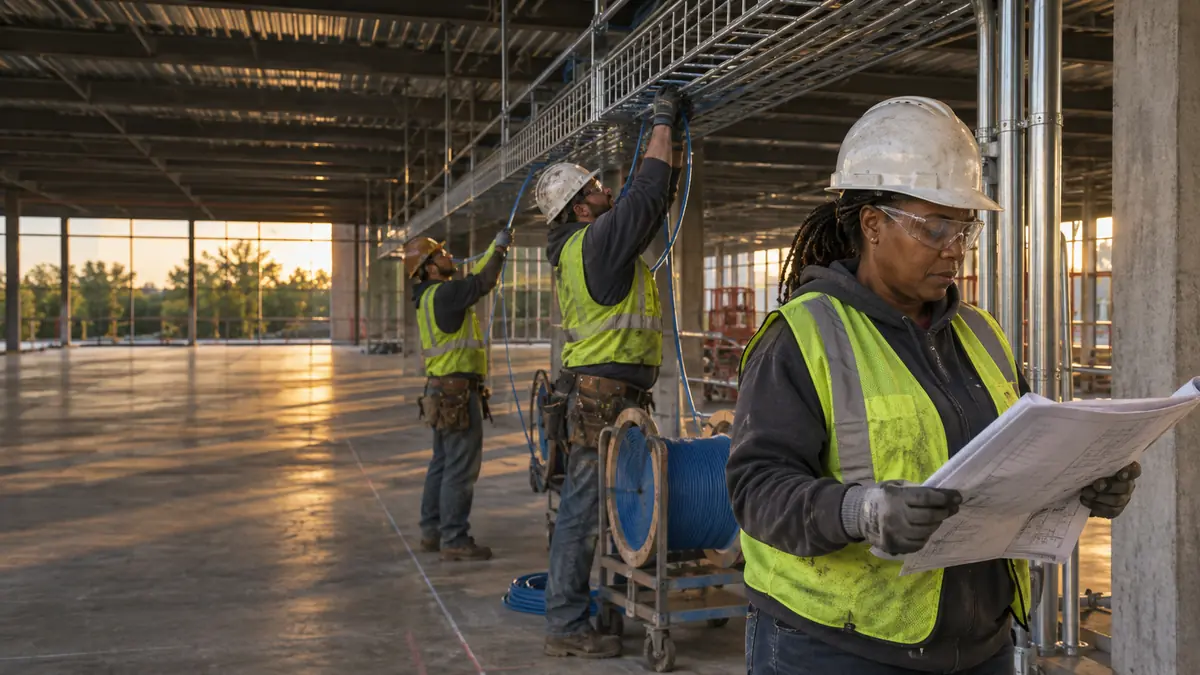
For electrical, low-voltage, mechanical, fire-protection and site subs on mission-critical jobs
Financing for subcontractors on data-center work
The owner is one of the biggest companies in the world. Your check still comes from the GC, after the GC is paid, minus retainage. Crossbrace Capital is a direct funder. We fund established subcontractors against approved pay apps on data-center, substation and fab work, and with weekly-payment business funding when the gap comes before you can bill.
5 taps. No contact details to see your number.
Check your cash gap
Up to 5 taps to an estimate. No contact details needed to see it.
Let's size the cash gap on a job. 5 taps at most, and you don't need to give contact details to see the number. Nothing is sent to us until you press Send at the end.
Your request is handled by Crossbrace Capital and its sister company Funding Futures, and either may call or email you about it. We do not sell your information. By pressing Send my request, I confirm I'm authorized to request business funding for this business and that it's for business purposes only. Automated calls and texts happen only if I checked those boxes. Privacy Policy · Terms · Disclosures
The money is real. So is the wait.
Data-center construction is now the biggest private building story in the country. The Census Bureau put private data-center construction at a $96.5 billion annual rate in September 2026, up 90% from a year earlier (Census, released Nov 2, 2026). Most of that money is power and cooling: in the US, the most advanced AI-ready facilities are costing $14 to $16 per watt to build, against a $12.08 national average (Turner & Townsend, 2026).
But very little of that work reaches smaller firms directly. In April 2026, 42% of contractors with more than $100 million in revenue were working on data-center projects, against 7% of contractors under $100 million (ABC, May 12, 2026). When a smaller sub does land a package, it is usually under a large GC or a tier-1 electrical or mechanical contractor, with that contractor's payment terms.
That's where the gap comes from:
You're paid by the GC, not the owner
Your receivable is owed by the GC or the sub above you. The owner's credit doesn't change who writes your check.
Pay-when-paid stacks up
Each tier waits for the tier above. Subcontractors wait 51 days on average to be paid, while GCs estimate 35 (Billd 2026 Market Report).
Retainage is held to the end
Typically 5 to 10% of every bill, and on a building that takes most of a year, the end is a long way off. 43% of subs wait more than 90 days for final payment and retainage (Siteline, 2026).
The crew travels, and payroll is the big number
On many hyperscale jobs the owner buys the switchgear, generators and chillers itself (BuilderMuse), so what a smaller sub really carries is labor: weekly payroll, overtime, lodging and per diem, every week from the first day.
Change work runs ahead of the paperwork
Subs report a median of 22 days from a T&M tag to a priced change order request, and 92% say change orders are not always paid in full (Clearstory 2026).
On colo, enterprise and utility work, the gear can come first too
Medium-voltage switchgear in the 15 kV class was quoted at 52 to 80 weeks in mid-2026 (Terrapin data via IndustrialSage, Nov 2026), and slot deposits land long before you can bill.
What one data-center package can tie up
On the example above, a $1.8 million, 32-week subcontract, the sub is out about $754,000 by week 12, the week before the first check lands. That's with an 11.7% margin on the job. Stretch the chain to 90 days and the low point is about $921,000 in week 16. Illustration, not an offer: hypothetical numbers, not a real client or terms, built with the same formula as our cash-gap calculator. Put in your own.
A job can be profitable and still run you out of cash. That's not a sign you bid it wrong. It's the shape of progress billing on a big, long job.
Two ways we fund data-center subs
Crossbrace Capital is a direct funder, so the funding decision is ours.
Receivables financing against approved pay apps
For work you've already billed and the GC has approved. We fund against the approved amount, net of retainage, and are repaid when the GC pays. It fits best when one or two big pay apps from a GC with a solid payment record are holding up your cash.
Before you sign, we'll explain in writing how the receivable is handled, including whether your GC would be notified and what share of the approved amount we fund.
Business funding with weekly payments
For the gap before you can bill: mobilization, gear deposits, the first payrolls. Repaid on a weekly schedule (daily is available when deposits come in daily). For contractors, we lead with weekly, because one payment a week lines up better with a weekly payroll and monthly pay-app checks.
Costs and terms depend on your business and are set out in writing before you sign. Plain-dollar cost disclosure in states that require one.
Who it's for: subcontractors in business at least 1 year, working on data-center, substation, power or fab projects. Existing advances don't rule you out.
What makes a data-center receivable fundable
Not every unpaid invoice is the same. Here's what matters, in plain terms:
- Approved, not just submitted. An approved pay app (or a GC-signed schedule of values update) is much stronger than a submitted one.
- Net of retainage. Retainage is real money, but it isn't due until closeout, and it can be reduced by backcharges. Plan around the amount actually payable now.
- Who pays you, and how they pay. The GC's or tier-1's payment record matters more than the owner's name. If one GC is most of your receivables, that is worth talking about up front.
- What your subcontract says. Pay-when-paid or pay-if-paid language, notice requirements, and any clause about assigning payments. Read anti-assignment clauses and receivables financing before you assume a clause stops you.
- Lien and waiver paperwork in order. Conditional and unconditional waivers that match what's been paid (AIA Contract Documents).
Funding and your prequal
On data-center work, the GC's prequal file is part of the job. Turner asks trade partners for a bank line-of-credit letter and a surety letter (Turner), and DPR asks for a bonding letter and a line-of-credit statement once a project passes set thresholds (DPR). Before you take any funding, ask three questions, of us or anyone else:
- What will the UCC filing cover? A filing against one receivable reads differently to a surety than a blanket lien on everything you own.
- How do payments come out? Weekly payments are easier to plan around month-end ratios than daily ones.
- Can I show the paperwork to my surety agent? You should be able to. Tell your surety before you sign, not after.
Bonded jobs. If your subcontract is bonded, payment bonds and surety consent can affect how a receivable is handled. Tell us up front and we'll say whether that job fits before you go further.
When it goes wrong, it goes wrong in public
Big projects produce big payment fights. Subcontractors on a Microsoft data-center project in Quincy, Washington filed about $70.9 million in claims (Levelset). A Texas builder filed a $34.2 million claim in a dispute over a Microsoft project (San Antonio Express-News). And a lower-tier sub on a Google-linked project went to court over unpaid work (CourtListener, United Tank Services v. United Industries Group). None of these owners was the one who missed a payment to the lower tiers; the point is that the size of the owner doesn't protect the bottom of the chain.
That's why we'd rather fund work that's approved and billed, and talk honestly about the parts that aren't.
Pick your trade
- Electrical subcontractors on data-center workswitchgear, medium-voltage and the biggest share of the budget
- Low-voltage and fiberdeep in the tiers, paid last
- Mechanical and pipingchillers, CDUs and liquid cooling
- Fire protectionpre-action systems, testing and late closeout
- Site and civilthe first money out on every campus
Where the work is
- Northern Virginia (Loudoun, Prince William)
- Columbus and New Albany, Ohio
- Phoenix and Mesa, Arizona
- Atlanta and Stanton Springs, Georgia
Market pages carry public permit, utility and payment-law facts. We don't have local offices in these markets; we fund subs who work there.
Substations, power and fab work too
The same cash gap shows up on the work around data centers: substations and transmission tie-ins, on-site power plants, and semiconductor fabs. These jobs often run longer and buy more gear up front, because utility scopes are less likely to be owner-furnished. If you're a sub on substation, utility or fab work, the same two products apply; choose "Substation or power" or "Fab" as the project type when you apply.
Already have an advance or a bank line?
Many subs on these jobs already carry an advance, an equipment loan or a bank line. That doesn't rule you out. We'll ask what you have and look at whether another payment fits your deposits, and you'll see the costs in plain terms before you sign.
Other ways subs fund this work
You have options, and some may fit better than us:
GC early-pay programs
Some GCs run their own. Turner's Accelerated Payment Program, for example, pays enrolled trade partners on approved pay apps within 5 business days of the period-through date (Turner). If your GC offers one and you qualify, it will usually beat outside funding on that job. We're most useful where those programs don't reach: other GCs, second-tier subcontracts, and costs you can't bill yet.
A bank line of credit
Usually the lowest cost if you qualify, but sized to your balance sheet, not your backlog. See advance vs line vs factoring.
Supplier terms
Distributors sometimes extend terms on gear for a known project.
Factoring
Similar to receivables financing; terms and notification practices vary by provider.
If one of these fits better, use it. If you need to close a gap one of them won't cover, send a request.
Frequently asked questions
Do you buy receivables from Microsoft, Amazon, Google or Meta?
No. On a typical data-center job, the owner pays the GC, and the GC or a tier-1 sub pays you. Your receivable is owed by whoever you contract with. We fund against approved pay apps from that GC or contractor. We have no relationship with any hyperscaler.
Can you fund retainage?
Retainage isn't payable until closeout and can be reduced by backcharges, so we plan around the amount that's payable now, net of retainage.
My subcontract says I can't assign payments. Does that rule me out?
Not automatically. Under UCC §9-406(d), which every state has adopted in some form (check your state's version), many contract terms that ban or require consent to assigning a right to payment are ineffective (Cornell LII). But there are limits, and your relationship with the GC matters. Read our guide and talk to your attorney. Tell us what your contract says when you apply.
Do I need to be in business a certain amount of time?
At least 1 year. That is our only published minimum.
I already have an advance. Can I still apply?
Yes. Existing advances don't rule you out. We'll ask about them and look at whether another payment fits your deposits.
What does it cost?
It depends on your business, the receivable and the term. You'll get the costs and terms in writing before you sign, with a plain-dollar cost disclosure in states that require one. We don't publish rates.
Will you contact my GC?
Ask us before you apply; we'll tell you up front whether the structure you're considering involves any notice to your GC, before you sign anything.
Keep reading
Guides and tools for data-center subs
Know your gap. Then talk to us.
Tell us about the job and who pays you. If we're not the right fit, we'll say so.
No SSN, date of birth or bank login to start.