
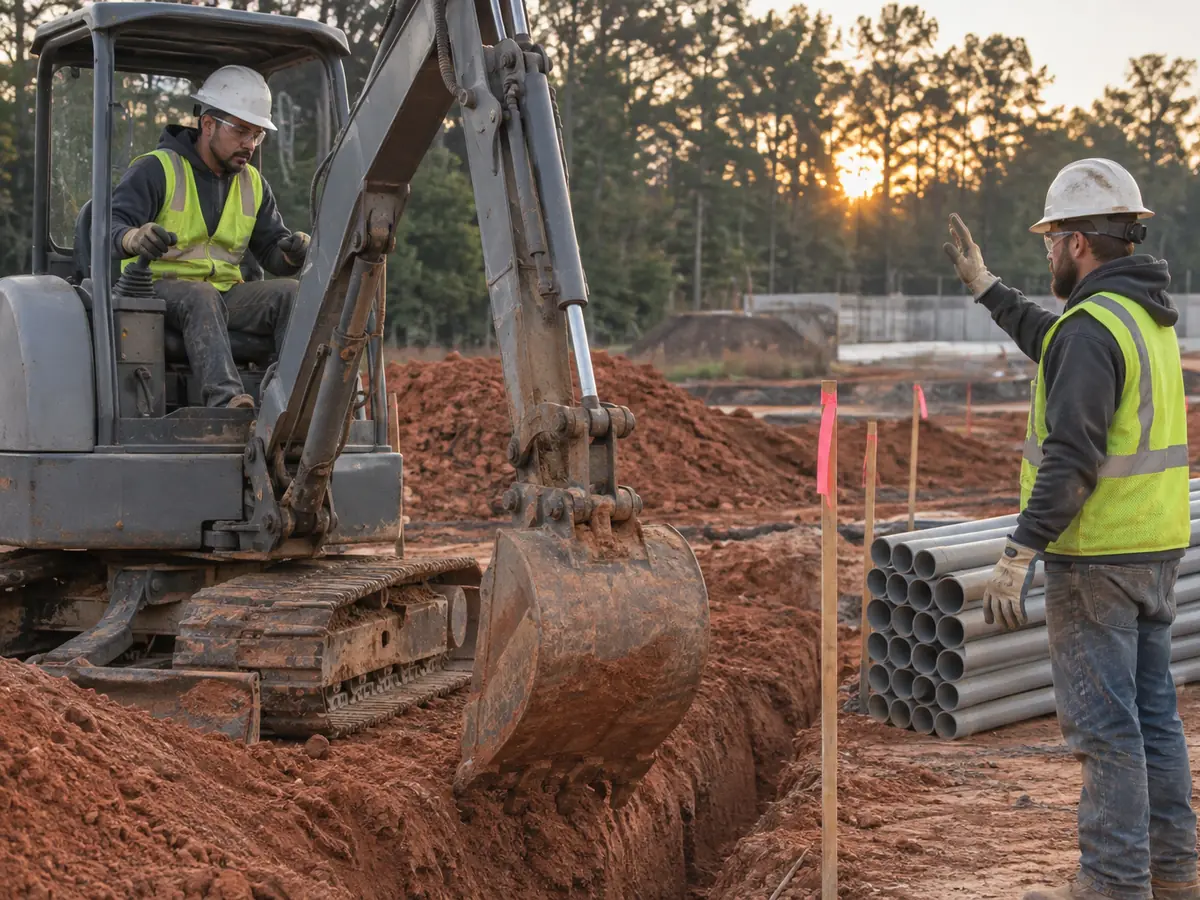
For excavation, grading, underground utility and sitework contractors
Working capital for site-work and utility contractors
Your iron, fuel and crew cost money every day the job is open, and the first check lands after the dirt work is mostly done. Crossbrace Capital helps established site and utility contractors carry the front of a job, with a plain-dollar cost disclosure in states that require one.
5 taps. No contact details to see your number.
Check your cash gap
Up to 5 taps to an estimate. No contact details needed to see it.
Let's size the cash gap on a job. 5 taps at most, and you don't need to give contact details to see the number. Nothing is sent to us until you press Send at the end.
Your request is handled by Crossbrace Capital and its sister company Funding Futures, and either may call or email you about it. We do not sell your information. By pressing Send my request, I confirm I'm authorized to request business funding for this business and that it's for business purposes only. Automated calls and texts happen only if I checked those boxes. Privacy Policy · Terms · Disclosures
Front-loaded work, back-loaded pay
Site work goes first. Clearing, mass excavation, grading, storm, sanitary and water lines all happen early in the project schedule, often at full crew and full fleet. That means a site contractor can be most of the way through its scope by the time the first pay app is paid. In our example below, the first check arrives in week 11 of a 12-week job.
And unlike most trades, the biggest weekly cost isn't materials. It's the machines: equipment notes or rental invoices, fuel, wear parts and repairs, plus operators and laborers. In our example that's about $46,000 every week the job is running.
Typical job: a $900,000 sitework package
A hypothetical 12-week sitework and utility package for a commercial pad:
- $900,000 contract, 12 weeks
- Materials (pipe, structures, stone) at 25% of the contract
- $26,000 a week in payroll and $20,000 a week in equipment, fuel and repairs
- Pay app every 4 weeks, paid net 45, 5% retainage released 45 days after completion
What the calculator shows:
- Peak cash gap: about $659,000, in week 10. By then, about 85% of the job's total cost has gone out the door (computed: $659K of $777K).
- First check: about $285,000, in week 11, for work billed in week 4.
- Only three checks (weeks 11, 15 and 19) pay for a job you finished in week 12.
- Retainage: $45,000, around week 19.
- Margin: about $123,000 (13.7%). A healthy job on paper that still needs most of its cost carried for two months.
Try your numbers Open the calculator with this example
Working a data-center campus? See site and civil subs on data-center work.
Your pay timeline
- Week 0MobilizeEquipment, fuel, crew
- Week 4You billPay app for earthwork
- Week 10GC gets paidOwner pays the GC
- Week 11You get paidLess retainage
- Week 19Retainage releasedAfter final acceptance
Week-by-week table
| When | Field | Office |
|---|---|---|
| Before week 1 | Lowboy and mobilization, erosion control, layout | Bonds, permits, mobilization line item (if your contract has one) |
| Weeks 1–4 | Clearing, mass ex, first utility runs | First pay app built on measured quantities |
| Weeks 4–10 | Utilities, grading, stone | Engineer or owner's rep verifies quantities; GC and owner approve; payment processed |
| Week 11 | Fine grade, paving prep | First check |
| Week 12 | Demobilize | Final quantities and pay app |
| Weeks 15–19 | Next job | Remaining checks and retainage |
Where the money goes first
Mobilization
Hauling equipment in, setting up erosion control, survey and layout. Some contracts pay a mobilization line item early; some state DOTs pay it in steps as the job progresses (for example, Michigan DOT pays mobilization in increments tied to earned contract value per its construction manual, accessed 2026-11-17). Check yours. See the mobilization cost checklist.
Fuel
The US average on-highway diesel price was $6.127 a gallon in the week of November 9, 2026, up $2.29 from a year earlier (EIA, accessed 2026-11-17). Off-road prices differ, but the direction matters for a bid made months ago.
Equipment breakdowns
One down excavator can idle a crew. Repairs don't wait for a pay app.
Unit-price quantity disputes
On unit-price work, you're paid for measured quantities. If the owner's rep counts less rock, less undercut or fewer feet of pipe than you do, that difference sits unpaid until it's resolved.
Weather days
Rain stops the work and the billing, not the equipment payments.
Hauling subs
If you sub out trucking, your haulers usually want to be paid in 30 days or less (how haulers see it).
Public and bonded work
A lot of site and utility work is public: municipal water and sewer, road widening, school sites. Public jobs bring payment bonds and prompt-payment laws, but also their own process and retainage rules, which vary by state. For example, Louisiana public contracts allow retainage of up to 10% on contracts under $500,000 and 5% at $500,000 or more (La. R.S. 38:2248, accessed 2026-11-17), and Ohio capped public retainage at 4% of labor for the whole job as of September 30, 2025 (Ohio Facilities Construction Commission HB 96 guidance, accessed 2026-11-17). More states: retainage laws by state.
On federal jobs, a sub without a direct contract with the prime has 90 days from its last work to give notice of a Miller Act payment-bond claim (40 U.S.C. § 3133, accessed 2026-11-17). Deadlines matter; see the GC slow-pay playbook. This is general information, not legal advice.
Questions we ask site and utility contractors
- What's the job, contract value and schedule, and is it public or private?
- What's your weekly burn: crew, equipment payments or rentals, fuel?
- Is the contract lump sum or unit price? How are quantities verified?
- Does the contract pay a mobilization line item, and when?
- What are your terms and retainage, and who is the paying party?
- What do your business deposits look like over recent months, including seasonality?
- Existing advances, loans or equipment notes with daily or weekly payments?
Fit and no-fit
Usually a fit
Established site and utility contractors with steady deposits, signed work and a gap that ends with a pay app or retainage release. One year in business is our only published minimum, and existing advances don't rule you out.
Usually not a fit
Buying a machine (equipment financing is usually cheaper), a winter with no work lined up, or a disputed job that may not get paid. We'll tell you when another option fits better (compare the options).
Product note: Crossbrace Capital is a direct funder. We fund site and utility contractors two ways: business funding repaid on a weekly or daily schedule (for contractors, we lead with weekly), and receivables financing against invoices and pay apps you've already billed. Costs and terms depend on your business and are set out in writing before you sign.
FAQ
Can I use funding for fuel and equipment repairs on a job?
Those are common uses for site contractors if they're approved uses. For buying equipment outright, compare equipment financing first.
My job is unit price. How do you look at that?
We look at your recent pay apps and how closely approved quantities have matched what you billed. Quantity disputes stretch the gap, so we ask about them.
Most of my work is municipal. Does slow public payment count against me?
Not by itself. Public owners can be slow but usually pay. We look at how long your public jobs have taken to pay in the past.
What about winter?
If your deposits drop every winter, we'll see it in your history. A gap that runs into a season with no work is harder to fit than one that ends with a check.
Do I need to give my SSN to start?
No.
What will it cost?
It depends on the file. Ask for the total cost in dollars and the payment schedule before you sign. Required disclosures are provided in states that require them.
Keep reading
Guides and tools for site work and utility contractors
Know your gap. Then talk to us.
Tell us about the job. If we're not the right fit, we'll say so.
No SSN, date of birth or bank login to start.